Introduction
One of the most challenging parts of the CFE Law section is understanding how legal evidence is gathered, preserved, and presented so it will be admissible in court. This article explains that specific problem—evidence collection and admissibility—in clear, practical terms and shows how the كتاب CFE الجزء الثاني عربي PDF لعام 2026 can help Arabic-speaking professionals master it. You will get concrete examples, a hypothetical work scenario, and actionable next steps you can implement immediately.
Why evidence collection is a frequent stumbling block
Professionals who investigate financial fraud often know where to look for suspicious activity but struggle with properly documenting and handling evidence so it meets legal standards. Mishandled evidence can be excluded at trial, weaken a civil claim, or even expose investigators to legal risks. The 2026 update in the referenced PDF focuses on modern rules for collecting electronic and documentary evidence and practical guidance on procedural safeguards.
Key elements that determine admissibility
- Chain of custody: Clear documentation showing who handled the evidence and when.
- Authenticity: Proof that a document or electronic record is genuine.
- Relevance and materiality: Evidence must relate directly to an element of the alleged fraud.
- Legality of collection: Evidence obtained in violation of rights or laws may be excluded.
How the course material helps you understand the problem
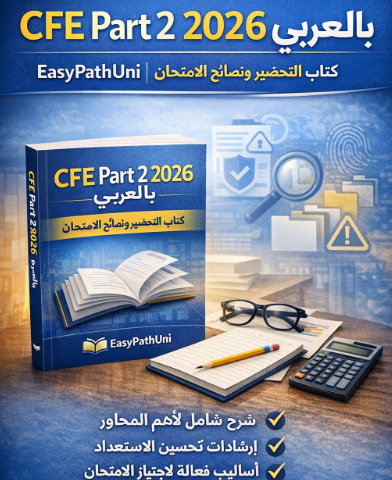
The EasyPathUni PDF for CFE Part 2 (Law) updated for 2026 provides a focused explanation of these legal concepts in Arabic, with simplified terminology and step-by-step checklists. According to the course summary, it includes sections on laws and procedures relevant to fraud, guidance on collecting forensic evidence, and sample questions to test application rather than rote memorization.
Practical features to look for in the material
- Legal summaries that highlight procedural requirements for admissibility.
- Mind maps that simplify complex statutory frameworks (criminal vs. civil rules).
- Sample evidence collection forms and suggested chain-of-custody templates.
- Practice questions that simulate courtroom objections and how to respond.
Hypothetical work example
Scenario: You are a compliance investigator at a regional bank. An internal audit flagged repeated wire transfers to a shell company. You identify an employee who authorized the transfers and find email exchanges that suggest collusion.
- Initial steps: Secure electronic records immediately. Take forensic images of relevant workstations and preserve server logs.
- Document chain of custody: Use a signed log each time a device or file is accessed. Note date, time, reason, and the person handling the item.
- Assess legality: Confirm your authority to access the employee’s communications under company policy and local law; obtain legal advice if there is any doubt about privacy or search rules.
- Authenticate documents: Capture metadata and corroborating evidence (e.g., system logs showing an employee’s access at relevant times).
- Prepare for objections: Anticipate claims that the evidence was tampered with or obtained without consent; keep a clear, contemporaneous record of the collection process.
This approach illustrates how collecting evidence without procedure can jeopardize a case. The course PDF’s Arabic explanations of these steps help professionals apply them consistently.
Actionable takeaways you can apply this week
- Create a simple chain-of-custody template you can use when you seize documents or devices. Include fields for date, time, handler, and reason.
- Practice making forensic images in a controlled environment or with IT support so you understand how metadata is preserved.
- Review your employer’s policies and local law on accessing employee records; when in doubt, seek legal advice before copying private communications.
- Write short, contemporaneous notes during every investigative step; courts and tribunals treat these notes as strong evidence of proper procedure.
- Use practice questions to rehearse how to respond to common legal objections; this strengthens your ability to justify collection choices under pressure.
Next steps and recommended resource
If you want a focused Arabic resource that explains the legal rules and practical procedures for evidence collection in fraud cases, consider the updated 2026 PDF guide. It provides simplified legal explanations, mind maps, and practice questions tailored for the CFE Law section. You can view details and download the PDF here: كتاب CFE الجزء الثاني عربي PDF لعام 2026.
Start by implementing one actionable item above (for example, creating a chain-of-custody template). Combine that habit with study of the course’s procedural checklists and practice questions to improve both your exam readiness and on-the-job evidence handling.
Understanding how to collect and preserve admissible evidence is not just an exam topic; it is a practical skill that protects investigations and strengthens legal outcomes. Use targeted study and deliberate practice to close that critical knowledge gap.
Next step: View the course details and start learning.