Select the text to read:

New Internal Auditor Onboarding – Part 2: Managing, Planning, and Delivering Audit Engagement

By Yazan Ibrahim Categories: Audit, CPE
Wishlist Share
Share Course
Page Link
Share On Social Media

About Course

Course Overview

Welcome to Internal Audit Practice, a comprehensive course designed to master the complexities of the internal audit profession. Based on global standards and best practices, this curriculum delves deep into the lifecycle of audit engagements—from the strategic management of the audit activity to the tactical execution of individual audits. Whether you are aspiring to become a Certified Internal Auditor (CIA) or seeking to enhance your practical skills, this course provides the structural framework needed to succeed.

Students will navigate through four distinct domains. First, we explore the management of the internal audit activity, focusing on policies, risk-based planning, and high-level governance reporting. Next, we transition into the planning phase of specific engagements, learning how to define objectives, scope, and resource allocation. The core of the course covers the performance of engagements, utilizing data analysis, evidence gathering, and documentation techniques. Finally, we cover the critical soft skills and procedural requirements for communicating results and monitoring management’s corrective actions.

By the end of this course, learners will be equipped with the knowledge to establish risk-based plans, supervise audit teams, utilize advanced analytical tools, and deliver high-impact reports to senior management and the board. Join us to elevate your understanding of how internal audit protects and enhances organizational value.

Show More

What Will You Learn?

  • Establish and operate internal audit policies and procedures effectively
  • Perform key administrative activities that support a high-performing audit function
  • Identify and justify sources of potential audit engagements
  • Apply risk management frameworks to prioritize the audit universe and annual plan
  • Differentiate and apply assurance engagement types appropriately
  • Differentiate and apply consulting engagement types appropriately
  • Coordinate internal audit work with other assurance providers to reduce duplication
  • Communicate the annual audit plan clearly to stakeholders
  • Report significant risk and control issues in a timely, structured way
  • Report on overall effectiveness of governance, risk management, and controls
  • Define and use internal audit KPIs to measure value and performance
  • Determine engagement objectives, criteria, and scope based on stakeholder needs and risks
  • Plan engagements to identify key risks and controls efficiently
  • Perform a detailed risk assessment of the audit area
  • Develop a complete engagement work program aligned to risks and objectives
  • Allocate resources appropriately for engagement delivery
  • Conduct information gathering and preliminary surveys to understand the audit area
  • Use checklists and risk-and-control questionnaires to standardize fieldwork
  • Apply sampling and basic statistical analysis to support conclusions
  • Use CAATs to improve audit efficiency and coverage
  • Evaluate evidence for sufficiency, reliability, relevance, and usefulness
  • Apply process mapping and analytical approaches to assess controls and workflows
  • Use analytical review techniques to detect anomalies and trends
  • Prepare high-quality workpapers and documentation that support conclusions
  • Develop defensible engagement conclusions based on evidence
  • Supervise engagements to ensure quality and consistency
  • Conduct preliminary communications with clients to align expectations
  • Apply communication quality standards and essential report elements
  • Use interim reporting when urgent issues require early escalation
  • Formulate practical, risk-based recommendations that improve controls
  • Execute the reporting process from drafting to final issuance
  • Assess residual risk after evaluating controls and recommendations
  • Communicate risk acceptance appropriately and document it
  • Assess engagement outcomes and client action plans
  • Monitor and follow up to confirm implementation and risk reduction

Course Content

Domain I: Managing the Internal Audit Activity

  • pdf file Internal_Audit_Practice_Managing_Planning_and_Performing_Engagements_Lessons
  • Policies and Procedures for Internal Audit Operations
  • Administrative Activities of the Audit Function
  • Identifying Sources of Potential Engagements
  • Risk Management Frameworks and Prioritization
  • Types of Assurance Engagements
  • Types of Consulting Engagements
  • Coordination with Other Assurance Providers
  • Communicating the Annual Plan
  • Reporting Significant Risk and Control Issues
  • Reporting on Overall Effectiveness
  • Internal Audit Key Performance Indicators (KPIs)
  • Domain I: Managing the Internal Audit Activity

Domain II: Planning the Engagement

Domain III: Performing the Engagement

Domain IV: Communicating Engagement Results and Monitoring Progress

Final Exam

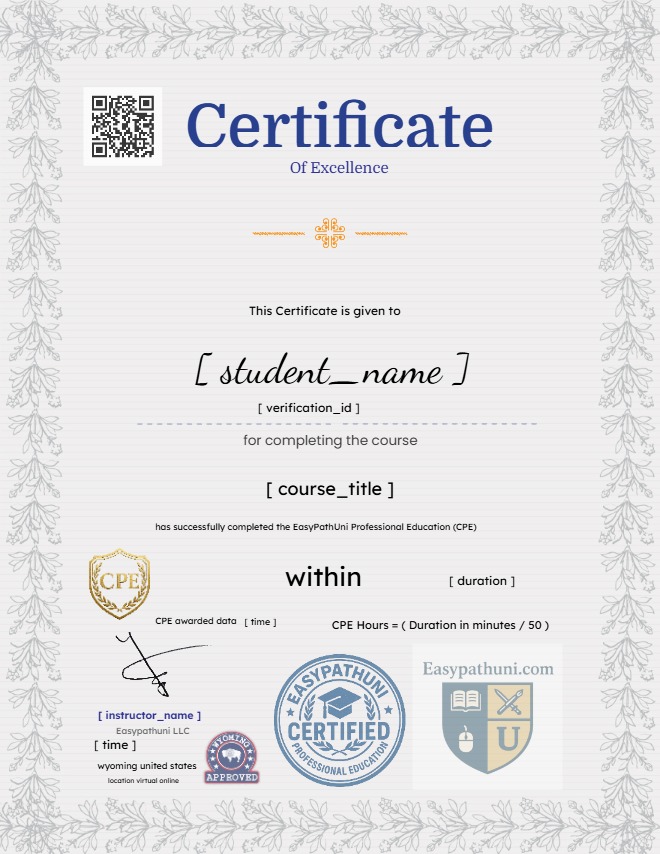
Earn a certificate

Add this certificate to your resume to demonstrate your skills & increase your chances of getting noticed.
selected template

Student Ratings & Reviews

No Review Yet
No Review Yet

Want to receive push notifications for all major on-site activities?