Introduction
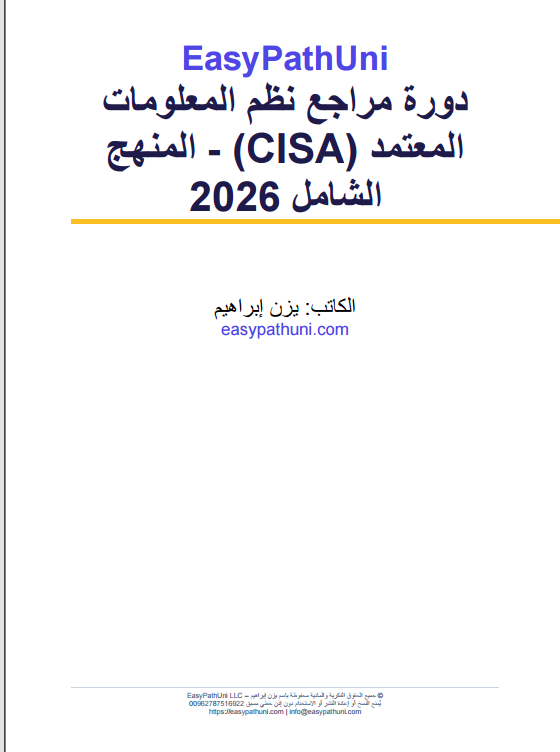
One of the most common and concrete problems IT auditors face is determining whether IT General Controls (ITGCs) are functioning effectively and whether the control evidence is sufficient and reliable. For professionals preparing for the CISA exam, or performing real-world audits, this challenge combines technical understanding, risk judgment, and clear documentation. The Arabic CISA PDF guide from EasyPathUni (updated for 2026) focuses on these core audit skills and explains how to approach ITGC testing with practical techniques and examples.
Why ITGCs matter and the core challenge
ITGCs (access controls, change management, backup/recovery, and operations) underpin the integrity of application controls and financial reporting. The specific problem auditors struggle with is not merely identifying a missing control, but designing tests that show whether a control operates consistently over time and across systems — and then interpreting exceptions in the context of business risk.
Practical steps to evaluate ITGC effectiveness
Below is a step-by-step approach you can apply during planning and fieldwork. These steps reflect the type of structured guidance found in the CISA Arabic PDF, which covers the five CISA domains and provides mind maps and exam-style questions to reinforce learning.
- Define the control objective: Translate the control into a clear objective. Example: "Ensure only authorized users can modify payroll records."
- Identify control types: Determine whether the control is preventive, detective, or corrective and whether it is manual or automated.
- Assess inherent risk: Consider system criticality, user population, exposure to external threats, and regulatory implications.
- Design tests of operating effectiveness: Select test methods such as inspection, observation, inquiry, re-performance, or data analytics. Prefer re-performance and data analytics where feasible.
- Sample appropriately: Choose sample sizes and selection methods that reflect the control frequency and risk. For periodic controls, sample across multiple periods.
- Document evidence: Capture original artifacts (logs, configuration screenshots, change tickets) and tie them to your findings with date/time stamps.
- Evaluate exceptions in context: Judge whether exceptions are isolated, systemic, or compensable by other controls.
Hypothetical work example: Testing change management for a payroll application
Scenario: You are auditing the change management process for a payroll application. The control objective is to ensure that code changes are approved, tested, and deployed following formal procedures.
- Scoping: Identify code repositories, change ticket system, responsible change advisory board (CAB), and production deployment logs.
- Control identification: The preventive control is role-based access to production; the detective control is deployment logs and post-deployment validation tests.
- Test design: Select a sample of 20 production deployments from the last six months.
- Evidence collection: For each sample, obtain the change ticket, approval records, test results, and automated deployment logs. Re-perform one deployment in a controlled test environment to verify the documented steps.
- Analysis: Use simple data analytics to confirm whether deployment timestamps match approval timestamps. Flag cases where production deployment precedes written approval.
- Findings and risk assessment: If 2 out of 20 deployments lacked approval prior to production, assess whether this was an isolated process lapse or indicative of weak control enforcement. Determine compensating controls, such as continuous monitoring or segregation of duties.
Actionable takeaways you can use immediately
- Start with a clear control objective: Articulate what the control is supposed to prevent or detect before selecting test procedures.
- Prefer evidence that is hard to alter: Configuration snapshots, immutable logs, and system-generated timestamps are stronger than manually compiled spreadsheets.
- Use small re-performance tests: Re-performing a single change process end-to-end often reveals documentation gaps better than large-scale sampling alone.
- Incorporate lightweight analytics: Even basic sorting and timestamp comparisons can quickly identify exceptions for further investigation.
- Document the professional judgment: Record why a sample size or specific test method was chosen, to support conclusions and defend the audit approach.
How the CISA Arabic PDF helps you apply these techniques
The EasyPathUni Arabic CISA guide (2026 edition) presents the five CISA domains with focused explanations of audit techniques like those above, plus mind maps and bilingual practice questions to reinforce the decision-making process. It emphasizes translating technical English terminology into clear Arabic explanations while preserving key technical terms — a useful balance for Arabic-speaking auditors who must both understand systems and pass the ISACA-style exam questions.
Next steps
If you want structured examples, sample test templates, and bilingual practice questions to practice the methods described here, consider the Arabic CISA PDF as a study companion. You can view details and download the guide here: EasyPathUni CISA Arabic PDF 2026. Start by applying the control-objective checklist in one ongoing audit and expand to automate simple analytics for recurring control tests.
Next step: View the course details and start learning.